

Life Line #1
What mitosis and mystics know. A life line that helped me through an extreme news week.

Life Lines is a series about lines from books I’ve recently read that offer some wisdom for dealing with the modern overwhelm of our times.
There was a time in my life when the week or so before Christmas would also be known to me as the “Season of Mitosis.” Not the season of giving. Not the season of giving or family or cookies or hot chocolate. At least not until all the freshmen I was working with made it through their biology final, a gauntlet that was promised to be rife with the intricacies of cell division.
For a long time, I worked as a high school learning specialist. My students often struggled with the kind of memory work that made biology textbook terms stick. I wasn’t wired for it either, but I did know a few tricks about how to make things stay in your memory long enough for the test. One favorite was to make it visual. So this time every year, I’d be elbow-deep in notecards, whiteboards, and markers, directing some stressed teenager to draw out the stages of cell division. I plied them with candy canes, too, because I’m no more a grinch than I am a biologist.
Judging by how often I did this (they got to move on from biology, but I repeated it every year) and how little I can tell you now about how it all works, I promise I’m not trying to come across here as knowledgeable in the field. But one image that has stuck around in my memory when mitosis season rolls around again is the part of the process when these two hairy clusters arrange themselves on either end of the cell and chromosomes line up in the middle in a row of neat little x’s. Like they’re holding hands. Like a prayer line right down the center.
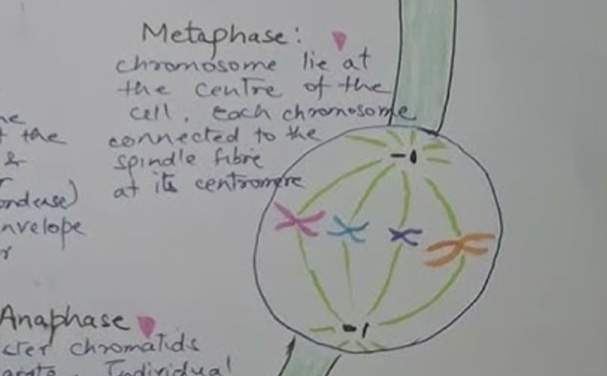
In cell division, this moment is called metaphase. It happens right before the cell breaks and becomes two new cells. The chromosomes gather at the center in formation, carrying critical information to pass along to the new cells about their purpose and abilities to grow and repair. It’s not a passive position. The chromosomes have a job to do. They choose the most efficient place to do that job and actively hold center before everything changes. What gets encoded at the center determines what the new thing will become.
I thought about this last week when I had one of those days where I felt almost high from being so helpful. A friend with ADHD was struggling with project overwhelm, and I swooped in with guidance and support. It felt GREAT! My personality felt all sparkly and zingy. I was using my professional expertise, solving problems, doing exactly what I was supposed to do. All my externals were getting rewarded with systems and smiles and satisfying items checked off of lists.
It felt great, but I was far from calm. I felt a lot more like a leaf waving around in the breeze on the farthest branch than feeling a calm and deep presence at my core to steady me. Something was off. I was doing a happy dance around a pole out on the edge, not feeling calm in the center, and I couldn’t figure out why.
To hold center, I had to move to release some energy. I used a centering prayer I turn to with my hand on my heart, “In you, I am.” I got quiet and just sat in curiosity about what was going on. And eventually, I realized I was getting way too enmeshed in a situation that I didn’t authentically fit into. I was leading with my desire to fix, rather than to be a friend, and those two things don’t mix well.
Finally, I thought about the values that matter most to me: love, kindness, and creativity. When I put those in the center, I knew that even though that kind of activity felt GREAT, it was an extreme sort of great that pulled me away from center. I decided to recommend an ADHD coach and offer a walk or a coffee date if she reaches out for help again.
Extremes have become so common, so frequent all around me, that running towards one of those poles feels like a default. About every few weeks, I seriously consider taking the kids out of their schools and moving to the mountains to raise what’s left of their childhoods in “nature’s classroom.” But the real radical in me is always challenging the default move. My inner radical says, “hold on, now. Maybe running in the total other direction isn’t the way to deal with this.” A line from Richard Rohr’s What the Mystics Know helped me understand why I may be drawn to extremes that keep me from true center:
“We no longer even have the tools to go inward because we are enamored of and entrapped in the private ego and its private edges. In such a culture, ‘the center cannot hold,’ at least not for long.”
-Richard Rohr. What the Mystics Know.
My private edges were hanging out having a great time and it was time for me to use some tools to go inward.
Holding center isn’t the same as centrism. And the act of holding a true center can be radical, even risky in our culture. After all, some of our best and most powerful stuff in the centers. Hearts. The smooth, rich ganache inside fancy chocolates. A regulated nervous system. The steady middle line of a lie detector test, or in other words, truth.
What the mystics knew is that holding center is a more radical position than we assume. To choose a slow and steady pursuit of values over feeling great. To be a friend rather than a rescuer. To hold connection over reaction when sharpening our edges feels like a much more attractive option.
Centering isn’t passive either. We made a whole verb out of it. Just like those chromosomes move to get in formation so they can deliver their messages to the new cells, holding center is active work. The poles of extreme information overload, violence, isolation, wealth gaps, egos, and reactions to all of the above threaten our alignment with essential resources for living that thrive in our center: meaning, truth, love, peace, presence, gratitude, curiosity, joy.
I am rarely shocked by the news now, but there was a day this week when it all seemed especially unrelenting—the violence, the reactions to the violence, so many words describing what was going on yet none of them creating clarity, understanding, or a sense of truth. At one point I even sent a screenshot of something from a source I usually trust to my husband with the question, “Is this real?” Of course it was. But the more extreme our extremes become, the less real they feel, and we start looking around for something that feels more true. What I find when I look around is the face of others who are also searching. Eyes meeting over the center of this dividing cell.
In cell division, metaphase happens right before the cell breaks and becomes two new cells. The chromosomes know, in their own way, that the center cannot hold. They have an urgent and imperative job to pass on what’s needed for the best parts of us to get encoded to whatever is becoming next. Centers don’t hold and they matter even more because of it.
I’ll surprise us all by ending with one more biology lesson. Maybe I am a biologist? Xylem exists in the center of trees to carry essential water and nutrients to all those outermost branches and leaves we love to gaze at, rest under, and thrill to see bud and bloom in the spring. Surprised by our surprise because even though it happens every year, we didn’t see all that was going on deep within the tree to give us the external show of its life. The tree is most alive at its center and right down to our cells, so are we.
Wishing you rest, quiet, and whatever brings you closer to center over the next few weeks.
with love,
Tricia
Wow, the "Season of Mitosis" part really resonated with me, especially how teachers sometimes have to become temporary experts in fields totally outside our main domain. I wonder if those intense memory tricks actually help build long-term understanding, or just get students past the imediate hurdle? It makes me think about how much raw information overload students today face, and you articulated the challenge so well. What's your secret for keeping yourself from getting overwhelmed by it all?